
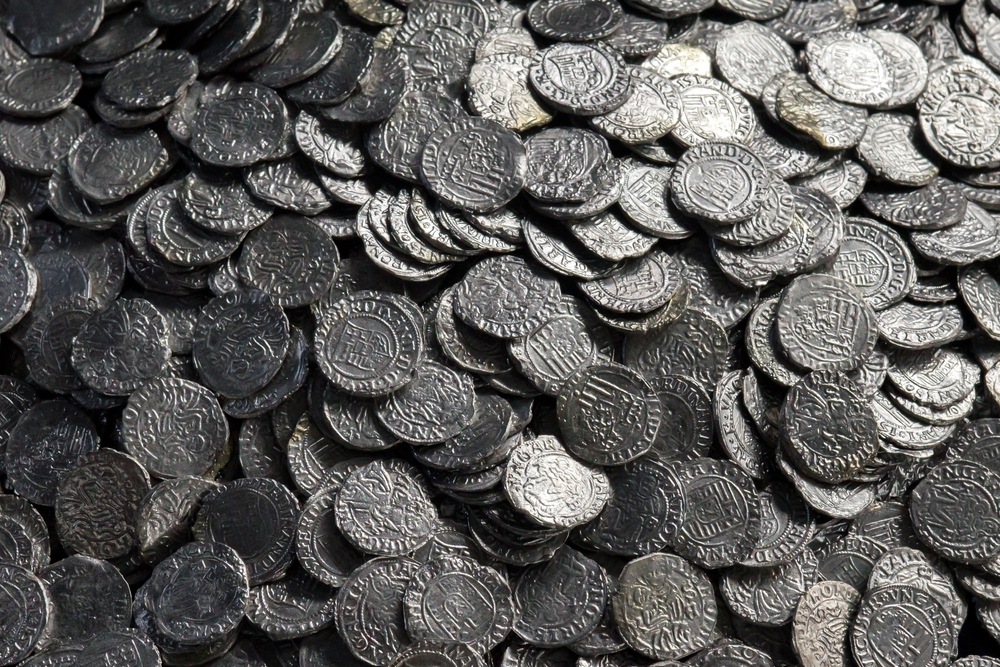
Gold may have seduced kings, but silver ran the world. For four millennia it was the everyday currency of empires, the lifeblood of global trade routes, and the raw material of human ingenuity — and its story is more complicated, more contested, and in many ways more interesting than its shinier rival.
There is a persistent tendency to treat silver as gold’s lesser companion — the supporting actor in a monetary drama that stars the yellow metal. This framing is almost entirely backwards. Measured by the volume of transactions it enabled, the number of people who handled it daily, the length of trade routes it animated, and the revolutions its scarcity or abundance helped trigger, silver has been the more consequential metal across most of recorded economic history. Gold was for gods and rulers. Silver was for everyone else — and everyone else, it turns out, is where most of history actually happens.
The full sweep of silver’s past moves from Anatolian mines in the third millennium BCE to the mountain of Potosí in colonial Bolivia, from the Greek treasury that funded the defeat of Persia to the Chinese imperial system that tied its entire monetary fate to a metal it did not mine. It runs through Islamic trade networks, medieval European commerce, the Atlantic slave trade, the Opium Wars, and the great American silver debates of the nineteenth century. Along the way it shaped languages — the word for money in French, Spanish, and Portuguese is simply the word for silver — and it left fingerprints on nearly every significant economic event between antiquity and the twentieth century.
Silver’s Origins: A Metal Born in Stellar Violence
Like gold, silver did not originate on Earth. It formed in the final moments of massive stellar explosions — supernovae and, more recently confirmed by gravitational wave observation, neutron star collisions — which scatter heavy elements across the galaxy. Silver arrived on the early Earth as part of the same meteoritic bombardment that delivered gold and other heavy metals roughly 3.9 billion years ago. Unlike gold, which tends to concentrate in pure metallic deposits, silver occurs in a wider variety of geological settings: as native silver in veins, alloyed with gold in electrum deposits, and combined with sulfur, lead, and other elements in ores like argentite and galena.
That mineralogical variety matters for the history of silver’s use. Many silver ores are visually unremarkable — dull, dark, and easily mistaken for lead ore. The extraction of pure silver from sulfide ores requires smelting, a technological leap that early metal-workers had to develop deliberately. The technique of cupellation — heating crushed ore with lead, then blowing air across the molten metal to oxidize and remove the lead, leaving a button of pure silver — was understood in Anatolia by at least 3000 BCE. This single process unlocked silver deposits across the ancient world that would have been inaccessible to any less sophisticated metallurgy.
The Ancient World: Anatolia, Greece, and the Mines of Laurion
The earliest large-scale silver production in the ancient world occurred in Anatolia, the region that is now Turkey. The site of Kültepe (ancient Kanesh) preserves cuneiform records from roughly 1900 BCE documenting a flourishing trade network in which Assyrian merchants transported textiles from Mesopotamia to Anatolia and returned with silver, which served as the medium of account for the entire operation. These are among the oldest commercial documents in existence, and silver is their constant protagonist.
But the most consequential silver deposits in the ancient Mediterranean were the mines at Laurion, located in the rugged hills of Attica about 65 kilometers southeast of Athens. Known since at least the seventh century BCE, the Laurion mines were worked intensively from the early fifth century onward by thousands of enslaved workers — many of them war captives — under conditions of extreme hardship. The ore was crushed, washed, and smelted in a complex of surface installations whose slag heaps are still visible today.
Silver and the Defeat of Persia
In 483 BCE, Athenian miners struck an exceptionally rich new vein at Laurion. The timing was politically electric. The Persian Empire under Xerxes was preparing a massive invasion of Greece that would come two years later. The question facing Athens was what to do with the windfall. The statesman Themistocles argued, against considerable opposition, that the silver should be used not to distribute to citizens as a bonus payment (the expected use of such a surplus) but to build a fleet of two hundred warships.
The Athenians agreed. Those ships, manned by Athenian rowers at the Battle of Salamis in 480 BCE, destroyed the Persian fleet and effectively ended Xerxes’ campaign. The Laurion silver did not just fund a battle — it changed the trajectory of Western civilization. Athens subsequently used its silver revenues to build the Parthenon, fund the cultural flowering of the classical period, and finance its long conflict with Sparta. The silver owl tetradrachm, struck from Laurion metal and stamped with Athena’s face and her sacred bird, became the dominant trade coin of the eastern Mediterranean for more than a century.
3000 BCE
Anatolian cupellation; earliest systematic silver smelting
483 BCE
Laurion windfall funds Athenian fleet; Salamis victory
269 BCE
Rome introduces the denarius, anchoring its economy to silver
700s CE
Islamic dirham becomes the dominant trade coin from Spain to Central Asia
1545
Potosí silver discovered; reshapes global trade permanently
1873
US demonetizes silver; the “Crime of 1873” controversy begins
Rome and the Denarius: Silver as Imperial Infrastructure
Rome built its monetary system on silver more decisively than on any other metal. The denarius, introduced around 269 BCE and eventually containing roughly 4.5 grams of silver, became the backbone of Roman commerce for five centuries. Soldiers were paid in denarii. Taxes were collected in denarii. Prices across the empire were quoted in denarii. The word itself — surviving in the French denier, the Italian denaro, the Spanish dinero, and the Arabic dinar — traces a linguistic fossil record of silver’s centrality to money across much of the world.
Rome sourced its silver from mines across the empire, with the richest deposits in the Iberian Peninsula. The silver mines of Carthago Nova (modern Cartagena) in Spain were so productive that at their peak they employed an estimated 40,000 workers and generated revenues sufficient to fund the Roman state’s military campaigns. Like the mines of Laurion, they ran on enslaved labor. The Roman historian Polybius noted that the mines worked day and night without interruption, a detail that conveys both their scale and the human cost at which they operated.
The Slow Debasement of Roman Silver
Rome’s story with silver is also a story of slow institutional failure. Beginning in the first century CE and accelerating dramatically in the third, emperors facing military pressures and fiscal deficits began reducing the silver content of the denarius — sometimes openly, more often by sleight of hand, adding base metals while maintaining the coin’s outward appearance. By the reign of Gallienus in the 260s CE, what was nominally called a silver coin contained perhaps 2 to 5 percent silver. The rest was bronze.
The consequences were predictable and severe. Merchants priced goods in terms of actual silver content rather than face value, which meant prices in nominal denarii rose accordingly. Hoarding of older, purer coins removed good money from circulation (a dynamic that economists would later formalize as Gresham’s Law: bad money drives out good). The inflationary spiral of the third century, partly a consequence of monetary debasement, contributed to the broader Crisis of the Third Century that nearly destroyed the Roman state. Silver’s debasement did not cause Rome’s fall — the causes were too numerous and complex for a single factor — but it was a reliable symptom of the political dysfunction that made collapse inevitable.
Medieval Silver: Islamic Dirhams, European Pennies, and the Mining Boom
The Islamic world inherited Roman monetary sophistication and adapted it brilliantly. The silver dirham, standardized by Caliph Abd al-Malik in 696 CE alongside the gold dinar, became the workhorse currency of a trade network stretching from the Iberian Peninsula to the fringes of Central Asia. Arab merchants carried dirhams along the Silk Road, across the Indian Ocean, and north through the Volga trade routes into Scandinavia — where, in a remarkable historical irony, Viking hoards have been found containing thousands of Islamic silver coins, acquired through trade and raiding over centuries of commercial contact.
In Western Europe, the collapse of Roman trade networks left a monetary vacuum that was filled imperfectly and gradually. Charlemagne’s monetary reform of around 794 CE standardized the silver penny (denarius) as the basic unit of account across the Carolingian Empire, establishing a system — one pound of silver divided into 240 pence — that survived in Britain in modified form until 1971. The silver for these coins came partly from mines at Melle in France and later from increasingly productive deposits in the Harz Mountains of Saxony, discovered in the tenth century.
The Medieval Mining Revolution
Between roughly 950 and 1150 CE, silver production in Central Europe expanded dramatically as new deposits were worked across the Harz region, Bohemia, and the Alpine foothills. This influx of silver money stimulated commerce, allowed towns to grow, funded cathedral construction, and enabled the development of more complex credit instruments. Economic historians sometimes call this period Europe’s first monetization — the moment when silver coins penetrated deeply enough into ordinary economic life that most transactions, not just elite ones, could be conducted in currency.
The mining towns that grew up around these deposits had a distinctive character: they were among medieval Europe’s most cosmopolitan communities, drawing miners, merchants, and craftsmen from across the continent. Goslar in the Harz, Jihlava in Bohemia, Schwaz in Tyrol — these were boomtowns in a medieval sense, places where fortunes could be made and the usual social hierarchies were somewhat loosened by the presence of new money and new people. The cultural and commercial dynamism they generated fed directly into the broader economic expansion of the High Medieval period.
Potosí: The Silver Mountain That Rewired the World
Nothing in silver’s history compares in scale or consequence to the discovery of silver at Cerro Rico — Rich Mountain — in what is now Bolivia in 1545. Within a decade of that discovery, the city of Potosí had grown from nothing to a population of 160,000, making it one of the largest cities in the world at the time, comparable in size to London or Seville. The mountain that loomed over it contained deposits of staggering richness: over the next 250 years, it would yield an estimated 41,000 metric tons of silver — roughly a fifth of all the silver mined worldwide in that period.
The silver of Potosí did not simply enrich Spain. It restructured global commerce. Spanish silver reales minted from Potosí metal — particularly the eight-real coin known as the “piece of eight” — became the first genuinely global currency, circulating from Manila to Amsterdam to Canton with a standardization and reliability that made them acceptable everywhere. The phrase “the dollar” descends directly from “thaler,” a Central European silver coin whose name itself derives from the Joachimstal mines in Bohemia — but the silver piece of eight was what established the template for a universal trade coin long before any formal dollar existed.
The Manila Galleons and the China Connection
The most remarkable trade circuit that Potosí silver created ran across the Pacific. Beginning in 1565, Spanish galleons sailed annually from Acapulco in Mexico across the Pacific to Manila in the Philippines, carrying American silver. At Manila, that silver was exchanged for Chinese silks, porcelain, and luxury goods carried by Chinese junks from the ports of Fujian province. The galleons then returned to Acapulco loaded with Chinese goods.
This arrangement persisted for 250 years and had consequences that shaped Chinese history. The Ming and Qing dynasties restructured their entire tax system around silver during this period, commuting payments in kind to payments in the metal. China’s demand for silver was effectively insatiable — estimates suggest that between one-third and one-half of all the silver produced in the Americas between 1500 and 1800 ended up in China. When the supply of American silver contracted in the early nineteenth century, partly due to the disruptions of the independence movements in Latin America, China experienced a severe monetary contraction. That contraction is one of the underappreciated causes of the social instability that set the stage for the Taiping Rebellion and eventually the decline of the Qing dynasty — a chain of causation that runs from the mines of Potosí to the collapse of imperial China.
The Human Cost of Potosí
The silver of Cerro Rico was extracted through a system of forced Indigenous labor called the mita, a Spanish adaptation of an Inca tribute institution. Each year, male Indigenous workers from a vast catchment area were required to spend several months working in the mines and the mercury amalgamation mills — a process that used liquid mercury to extract silver from crushed ore and exposed workers to mercury vapor with devastating health consequences. Estimates of the total death toll directly attributable to Potosí’s mines and mills range from several hundred thousand to eight million over the colonial period. A Bolivian saying describes Cerro Rico as a mountain that eats men. The silver that built European cathedrals, funded Spanish wars, and circulated in Chinese markets arrived at a cost measured in human lives of a scale that beggars comprehension.
Silver and the Price Revolution in Europe
The flood of American silver into European markets across the sixteenth and seventeenth centuries drove a prolonged inflationary episode that economic historians call the Price Revolution. Between roughly 1500 and 1650, prices across Europe roughly doubled or tripled in nominal terms — modest by modern standards but dramatic by the standards of a society accustomed to centuries of relative price stability. The causes were debated at the time and remain contested among historians today, with American silver being the most significant single factor but not the only one.
The distributional consequences of this inflation were severe. Landlords on fixed rents saw their real incomes decline. Wages for agricultural laborers, slow to adjust, fell in real terms. Merchants and early capitalists, who could adapt their prices quickly, fared better. The Price Revolution thus contributed to the social tensions and class realignments that fed into the religious wars, peasant revolts, and political upheavals of the sixteenth and seventeenth centuries. In this indirect but significant way, the silver of Potosí and the other American mines shaped the political landscape of early modern Europe.
Silver in Asia: Japan, the Silk Road, and the Indian Rupee
Silver was not exclusively a Western monetary obsession. Japan emerged as a major silver producer in the sixteenth century, particularly after the development of the Iwami Ginzan mines in Shimane Prefecture — at their peak among the largest silver mines in the world. Japanese silver, like American silver, flowed primarily toward China, carried by Portuguese and Dutch traders who served as intermediaries between the Japanese and Chinese markets. The scale of Japanese silver exports was large enough to affect silver prices across East Asia.
India’s relationship with silver was both monetary and cultural. The Mughal rupee, introduced by Akbar the Great in the 1560s as part of a broader monetary reform, was a silver coin of high purity and consistent weight that became the standard currency across the subcontinent. The word rupee itself derives from the Sanskrit rupa, meaning silver. In Indian households, silver was not merely money — it was the primary form of household savings and insurance, accumulated as jewelry and vessels that could be melted and converted to cash in times of need. This tradition persists today, making India consistently one of the world’s largest silver consumers.
The Silver Debate: Bimetallism, the Gold Standard, and “Free Silver”
The nineteenth century brought silver to the center of some of the most heated political and economic debates in American and European history. For most of the century, major economies operated on a bimetallic standard — both gold and silver served as monetary bases, with a fixed legal ratio between them. The practical problem with bimetallism was that market prices for the two metals fluctuated, making it impossible to maintain a fixed ratio that matched reality. Whichever metal was undervalued at the legal ratio would disappear from circulation, hoarded or exported by those who understood its true market value — precisely the dynamic described by Gresham’s Law.
The Crime of 1873
In 1873, the United States Congress passed the Coinage Act, which effectively demonetized silver by discontinuing the minting of the standard silver dollar. The timing was politically explosive. New silver deposits discovered in Nevada and elsewhere in the American West had increased silver supply and reduced its price, meaning that silver producers and debtors who wanted an inflated money supply had strong economic reasons to oppose the shift to a pure gold standard. They named the act the “Crime of 1873” — a phrase that captured their sense that an economic interest had been betrayed by legislative sleight of hand.
The political movement that grew from this grievance — the Free Silver movement — culminated in the 1896 presidential election, one of the most consequential in American history. William Jennings Bryan, the Democratic candidate, gave his famous “Cross of Gold” speech at the Democratic National Convention, arguing that workers and farmers were being crucified on a gold standard that deflated prices, made debts harder to repay, and served the interests of Eastern bankers at the expense of ordinary Americans. Bryan lost the election to William McKinley, and with it the silver cause effectively lost its national political platform. But the issues he raised — about who monetary policy serves and at whose expense — have never entirely disappeared from American political life.
Silver in the Industrial Age and Beyond
As the twentieth century progressed, silver’s monetary role contracted while its industrial role expanded. The abandonment of silver coinage in most countries during the mid-twentieth century — the United States stopped producing silver dimes and silver quarters in 1965 — freed the metal from monetary constraints and allowed its price to be determined by industrial supply and demand alongside investment speculation.
Silver’s physical properties make it uniquely valuable in industry. It has the highest electrical conductivity of any element, the highest thermal conductivity of any metal, and a natural antibacterial effect that has been recognized since antiquity. These qualities put it in solar panels (where silver paste conducts current from photovoltaic cells), in electronics of every kind, in medical applications from wound dressings to surgical instruments, in mirrors and optical coatings, and in photography — where silver halide chemistry dominated the field for more than a century before digital imaging replaced it. The decline of photographic demand in the early 2000s was more than offset by growing solar panel and electronics demand, so that by the 2020s industrial applications account for roughly half of all annual silver consumption.
The Hunt Brothers and the 1980 Silver Squeeze
Silver’s modern history includes one spectacular episode of market manipulation. In the late 1970s, the Hunt brothers of Texas — Nelson Bunker Hunt and William Herbert Hunt — began accumulating silver on a massive scale, eventually controlling an estimated one-third of the world’s privately held silver supply. Their purchases drove the silver price from around $6 per ounce in 1979 to a historic high of $49.45 per ounce in January 1980. Regulators, alarmed at the market distortion, changed margin requirements on silver futures, and the price collapsed just as dramatically as it had risen. By March 1980, silver had fallen below $11 per ounce. The Hunts were left with positions they could not cover and eventually declared bankruptcy. The episode demonstrated that silver’s relatively small market size compared to gold made it more susceptible to price manipulation — a characteristic that has attracted speculative interest repeatedly in the decades since.
Silver’s Cultural Life: Language, Art, and Mythology
No account of silver’s history would be complete without acknowledging how deeply the metal embedded itself in human symbolic life. The association of silver with the moon — as gold is associated with the sun — runs through ancient Egyptian, Greek, Roman, Hindu, and Mesoamerican cosmologies independently, a remarkable convergence that may reflect silver’s pale, reflective quality and the nocturnal character of its light. The moon goddess Artemis in the Greek tradition, Diana in the Roman, carried silver arrows. The alchemical symbol for silver was a crescent moon.
Silver entered the English language with extraordinary persistence. To be born with a silver spoon is to be born to wealth. Every cloud has a silver lining. The silver screen named cinema in its early decades. A silver tongue belongs to the smooth and persuasive. In folklore, silver bullets kill werewolves and repel evil — a tradition rooted in the metal’s perceived purity and its historical use in amulets. The word “sterling,” as in sterling silver and the British pound sterling, derives from the Old Norman French esterlin, referring to the silver coins brought by Norman merchants to England — a linguistic trace of medieval monetary history that survives in modern English.
In the decorative arts, silver has produced some of the finest craft objects in the human record. The Sassanid Persian silver dishes of late antiquity, Byzantine reliquaries, Mughal huqqa bases, English Georgian flatware, and the extraordinary silverwork of the Andean colonial tradition — all represent silver’s capacity to attract the most skilled craftspeople of any era and to inspire work of exceptional quality. That tradition is not merely historical: studio silversmiths continue to work today in direct continuity with craft traditions stretching back to the earliest ancient smiths.
The Modern Silver Market and Its Future
Silver in the twenty-first century occupies an unusual position — simultaneously an industrial metal, a monetary relic, an investment vehicle, and a craft material. Its price is determined by a complex mix of industrial demand (especially from solar energy, which has become its fastest-growing end use), investment flows, mine supply, and speculative activity. Annual mine production runs at roughly 25,000 to 27,000 metric tons globally, with Mexico, Peru, China, Russia, and Australia as the leading producers. Above-ground silver stocks are substantially smaller relative to annual demand than gold stocks, which makes silver’s price more volatile — capable of dramatic swings in both directions on relatively modest changes in demand or supply.
The energy transition is reshaping silver’s economic geography in real time. Each solar panel requires a small quantity of silver paste to conduct electrical current from its cells, and the global scale-up of solar capacity is adding meaningfully to demand. By some industry estimates, the solar sector could account for 15 to 20 percent of total annual silver demand within the next decade — a structural shift with significant implications for pricing and supply chains. Mining companies, investors, and industrial users are all recalibrating their assumptions about a metal that has surprised human expectations, repeatedly and dramatically, across four thousand years of recorded use.
Silver never quite behaves the way people expect it to. It was underestimated by those who thought gold alone mattered, overestimated by those who bet too heavily on its monetary return, and consistently more useful than either group imagined in directions they had not anticipated. That pattern — of a metal that keeps finding new relevance just as its old relevance fades — is perhaps the most consistent thread in a history that is otherwise almost impossibly varied. From the silver owl of Athens to the photovoltaic panels of the Atacama Desert, the story of silver is the story of human ingenuity discovering, again and again, that this particular element has one more surprise left in it.
In 2026, silver prices hit new all-time highs, topping out at $121.62 per ounce.
Click here to check out The History of Gold.
Frequently Asked Questions About the History of Silver
When was silver first used by humans?
The earliest evidence of deliberate silver smelting dates to around 3000 BCE in Anatolia (modern Turkey), where metalworkers developed the cupellation process to extract pure silver from lead-bearing ores. Silver objects appear in the archaeological record in Mesopotamia and the Aegean from roughly the same period, and silver served as a medium of account in Assyrian trade networks documented in cuneiform tablets from approximately 1900 BCE. The metal was known and worked in some form even earlier — small silver ornaments have been found in Chalcolithic contexts dating back to around 4000 BCE — but systematic large-scale production began in the third millennium BCE.
How did the silver mines at Laurion affect ancient Greek history?
The Laurion silver mines in Attica were central to Athenian power in the classical period. A major silver strike in 483 BCE provided the wealth that the statesman Themistocles persuaded Athenians to invest in a fleet of warships rather than distribute as citizen dividends. That fleet defeated the Persian navy at Salamis in 480 BCE, effectively ending Xerxes’ invasion. Subsequent Laurion revenues funded the construction of the Parthenon and other Acropolis monuments, financed Athenian military campaigns, and backed the silver owl tetradrachm, which became the dominant trade coin of the eastern Mediterranean for more than a century.
What made Potosí so historically significant?
The silver deposits discovered at Cerro Rico in present-day Bolivia in 1545 were among the largest ever found. Over roughly 250 years, Potosí yielded an estimated 41,000 metric tons of silver, helping to make the Spanish piece of eight the first genuinely global currency. Potosí silver restructured international trade, drove European inflation (the Price Revolution), financed China’s monetary system through the Manila galleon trade, and funded the Spanish imperial project. It also came at an enormous human cost, extracted through a system of forced Indigenous labor called the mita that caused hundreds of thousands to millions of deaths. Its legacy is present in everything from the word “dollar” to the architecture of Lima and the monetary history of China.
What was the “Crime of 1873” in American history?
The Coinage Act of 1873 effectively demonetized silver in the United States by discontinuing the standard silver dollar. Critics — particularly Western silver miners, farmers, and debtors who wanted an expanded money supply — called it the Crime of 1873, arguing it was a conspiracy by Eastern banking interests to impose a deflationary gold standard at the expense of ordinary Americans. The controversy fueled the Free Silver political movement, which reached its peak in William Jennings Bryan’s 1896 presidential campaign. Bryan’s famous “Cross of Gold” speech at the Democratic National Convention argued that ordinary workers and farmers were being destroyed by gold-standard deflationary policies. Bryan lost the election to McKinley, ending silver’s best political chance for remonetization.
Why did silver coins disappear from everyday circulation?
Silver coins disappeared from everyday use in most countries during the mid-twentieth century, primarily because rising silver prices made the metal content of coins worth more than their face value — creating an incentive to hoard or melt them rather than spend them. The United States shifted its dimes and quarters from 90 percent silver to copper-nickel clad compositions in 1965. Most other industrialized nations made similar transitions during the same period. The underlying problem was the same one that afflicted Rome’s denarius centuries earlier: when a coin’s metallic value exceeds its monetary value, the coin disappears from circulation. Fiat currency, backed by government authority rather than metal content, permanently resolved this tension.
What are silver’s most important industrial uses today?
Silver’s exceptional physical properties — the highest electrical conductivity of any element, high thermal conductivity, natural antibacterial qualities, and excellent reflectivity — make it indispensable across several industries. The largest industrial applications include photovoltaic solar panels (where silver paste conducts electrical current from cells), electronics of all kinds (circuit boards, contacts, switches), medical devices and antimicrobial materials (wound dressings, surgical instruments), mirrors and optical coatings, and brazing alloys used in manufacturing. Photography, once a dominant silver end-use, has declined substantially with the shift to digital imaging. Solar panel demand has grown rapidly and is expected to become an increasingly large share of total silver consumption through the 2020s and beyond.
What happened during the 1980 silver price spike?
Between 1979 and January 1980, silver prices surged from around $6 per ounce to a then-record high of $49.45 per ounce, driven primarily by the Hunt brothers of Texas — Nelson Bunker and William Herbert Hunt — who had accumulated an estimated one-third of the world’s privately held silver supply in an attempt to corner the market. Regulators responded by changing margin requirements on silver futures, triggering a rapid price collapse. By March 1980, silver had fallen below $11 per ounce. The Hunts faced catastrophic losses and ultimately declared bankruptcy. The episode illustrated silver’s susceptibility to price manipulation due to its relatively small and thinly traded market, and it set a price ceiling psychology that persisted for decades before silver eventually exceeded those levels in subsequent bull markets.
How is silver connected to the development of photography?
Silver chemistry was foundational to photography from its invention in the 1830s through the rise of digital imaging in the early 2000s. Silver halide compounds — silver chloride, bromide, and iodide — are photosensitive, meaning they darken when exposed to light in a predictable and controllable way. Louis Daguerre’s daguerreotype process (1839) used silver-coated copper plates sensitized with iodine vapor. Subsequent photographic technologies refined this chemistry into the gelatin silver print process that dominated black-and-white photography for over a century, and into the color film technologies used in consumer and professional photography until digital sensors replaced them. At its peak, photographic demand accounted for a substantial portion of global silver consumption; its decline after 2000 required the silver market to absorb a major structural demand shift.
Which countries produce the most silver today?
Mexico is consistently the world’s largest silver-producing country, typically accounting for roughly 20 to 25 percent of global mine output annually. Peru is generally the second-largest producer, with China, Russia, Chile, and Australia following in varying order depending on the year. Silver is rarely mined as a primary product — the majority of silver produced globally comes as a byproduct of mining lead-zinc, copper, and gold ores, which means silver supply is partly influenced by production decisions in other metals markets. Total global mine production runs at approximately 25,000 to 27,000 metric tons per year, supplemented by recycling from electronics, photography, and jewelry.